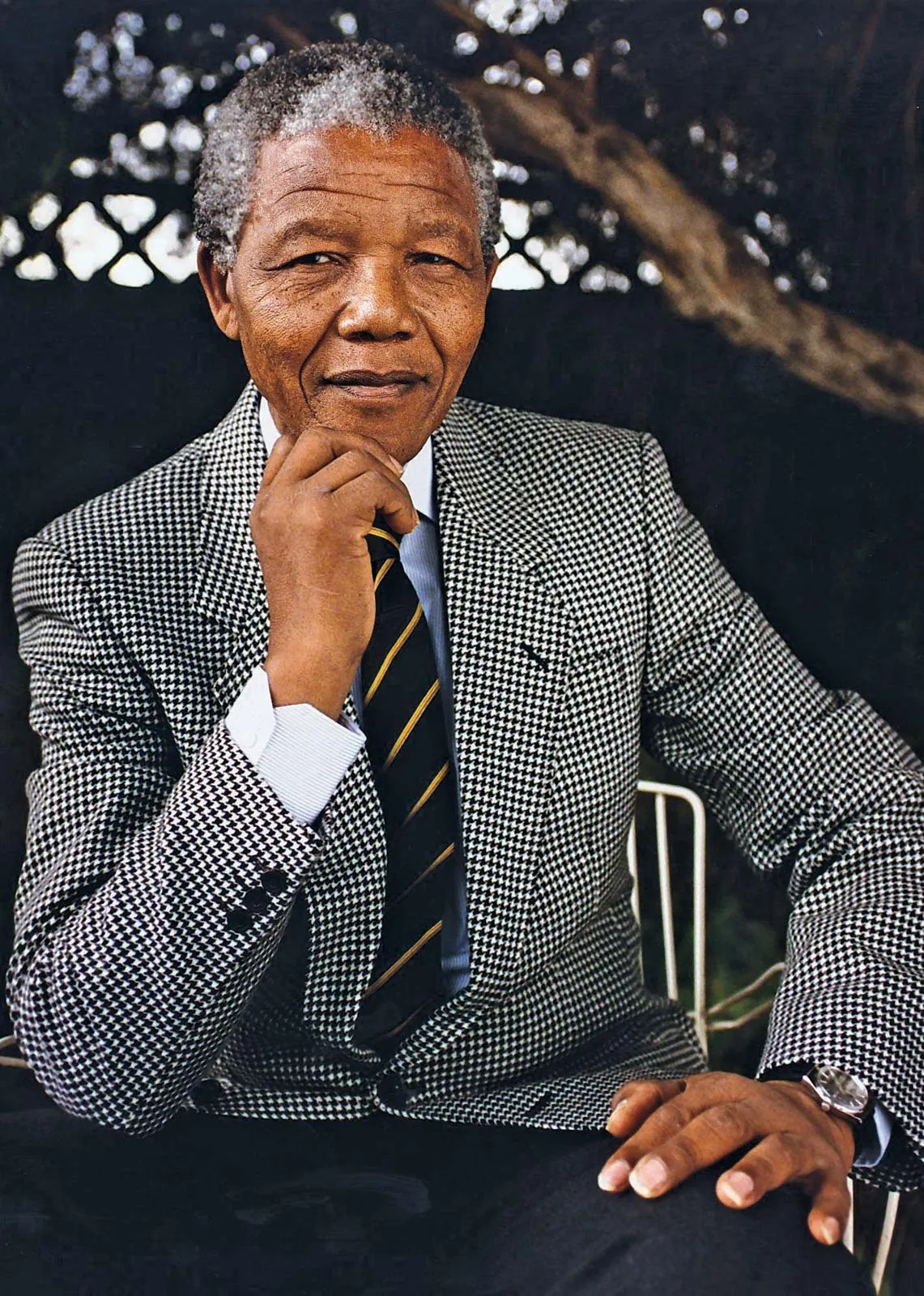
Nelson Mandela (1918–2013) stands as a monumental figure in the transition from a society governed by the Law of Force to one striving for a culture of dignity. His life, famously documented in his autobiography, Long Walk to Freedom, serves as a masterclass in how independent agency and rational capacity can dismantle even the most entrenched human-degrading systems.[1]
Nelson Mandela: From Resistance to Responsible Freedom
Mandela’s journey began within the rigid political power dynamics of South Africa’s Apartheid system, a structure designed specifically to strip the majority of their intrinsic worth. In Long Walk to Freedom, Mandela reflects on how the “cycle of conflict” was sustained by the state’s refusal to recognize the unique intellectual and moral capacities of its citizens.[2]
During his twenty-seven years of imprisonment, Mandela underwent a profound ideological development. He moved beyond the desire for mere retaliation, realizing that “to be free is not merely to cast off one’s chains, but to live in a way that respects and enhances the freedom of others.” This shift represents the ultimate responsible use of freedom, where the goal is no longer dominance, but the restoration of the social order.
The Power of Empathy and Reconciliation
One of Mandela’s most significant contributions to the “pursuit of flourishing” was his refusal to allow the transmission of pain to dictate the future of South Africa. Upon his release, he utilized his rational capacity for problem-solving to navigate a peaceful transition to democracy.[3]
He championed the Truth and Reconciliation Commission, a practical application of moral virtues that allowed the nation to confront its past without being consumed by it. He understood that buildling a government on “in-group and out-group” biases would only keep the nation trapped in conflict.
The Global Struggle for Dignity
In our book, Conflict: Recognizing Human Dignity as a Solution to Humanity’s Greatest Challenges, we discuss how the “recognition of shared dignity” is the only true solution to humanity’s greatest struggles. Mandela lived this truth, arguing that love and respect are the more natural human tendencies.
By choosing to lead with empathy rather than the Law of Force, Mandela became a global symbol for the preservation of dignity. His legacy reminds us that even when faced with the most “human-degrading” circumstances, the human spirit can choose a path of reconciliation and peace.
This article is part of our Historical Figures series on the History of Human Dignity.
Verified Sources
-
- Nelson Mandela Foundation. “Biography of Nelson Mandela.” nelsonmandela.org. ↩
- The Nobel Prize. “Nelson Mandela – Biographical.” nobelprize.org. ↩
- Britannica. “Nelson Mandela and the Truth and Reconciliation Commission.” britannica.com. ↩
Contribute to the Dialogue