
Why does conflict exist?
In 2022, we began efforts to hypothesize the source of conflict. The research to understand conflict from a historical point of view consisted of categorizing historical events by influential factors of conflict. We regurgitated history from our research – starting from the beginning of life on Earth and ending with modern day – to try to establish an unbiased understanding of the human story in one place. Once we had a chronological order of events with respect to conflict, questions arose. Why did early migrations on earth happen? Why did the neanderthal go extinct? When did we begin communicating? When did the rule of law begin?
With all of these questions, we came to a deeply rooted conclusion that when humanity developed the ability to think and develop ideas, humanity learned not just how to survive, but how to plan to survive. Humanity developed the faculty of the mind that allows for reasoning, abstraction, and the discernment of truth. This intellect, driven by our senses as a method of survival, became instinctual. Planning to thrive became more important than coexisting in a simple state of survival.
We hypothesize that conflict is not a failure of human nature, but a direct consequence of human intellect; once we gained the power to ideate, we gained the capacity to unite or divide through our intellect, which is fundamental to the modern day human experience. This hypothesis allowed us to begin laying the groundwork for our understanding of why conflict exists. We broke the hypothesis into the three influential factors of conflict:
1. Ideological Developments – Through intellect, humanity shared ideologies with one another, leading to shared purpose.
2. Political Power Dynamics – With shared purpose, humanity created organized methods of coexistence in order to thrive.
3. Technological Advancements – As groups in humanity became rich in resources, technology advanced rapidly in respective groups.
Founded on the cyclical nature of conflict throughout history, we moved forward with two fundamental beliefs that also stood out in history:
1. Humanity has an inherent desire for Good.
2. Conformity almost always has a role in Conflict.
Digging deeper, Humanity’s Inherent Desire for Good reminds us that ideological developments, however diverse, often emerge from a genuine intent to benefit the in-group. Yet this well-meaning intent is rarely thoughtfully extended beyond those who share the same ideological alignment.
Conformity’s Role in Conflict is evident in pressures to sustain ideologies within groups, creating divisions and tensions with other groups. These dynamics are often amplified by unstable political, economic, or technological forces, leading to what we later call human-degrading conflict. While conformity offers the comfort of in-group safety, it requires the surrender of individual freedom. Human-degrading conflict ensues when we prioritize the safety of conformity over the individual responsibility to question whether our group’s ‘Good’ is causing another group’s ‘Harm’.
We found that, as groups move forward with differing ideologies – regardless of the goodness of their ideologies – human-degrading conflict ensues. Why does human-degrading conflict ensue?
Today, we witness endless forms of conflict throughout the day. Differing ideologies collide at every intersection in life (literally and metaphorically). Whether it is geopolitical conflict, work conflict, conflict on the road, conflict in our own home, or conflicting thoughts in our mind – conflict is everywhere. But it isn’t all human-degrading. In fact, some conflict is a good thing and is necessary.
After researching the history of humanity in order to understand the source and consistent nature of conflict, we concluded that Conflict has a consistent nature. We call this The Cycle of Conflict:
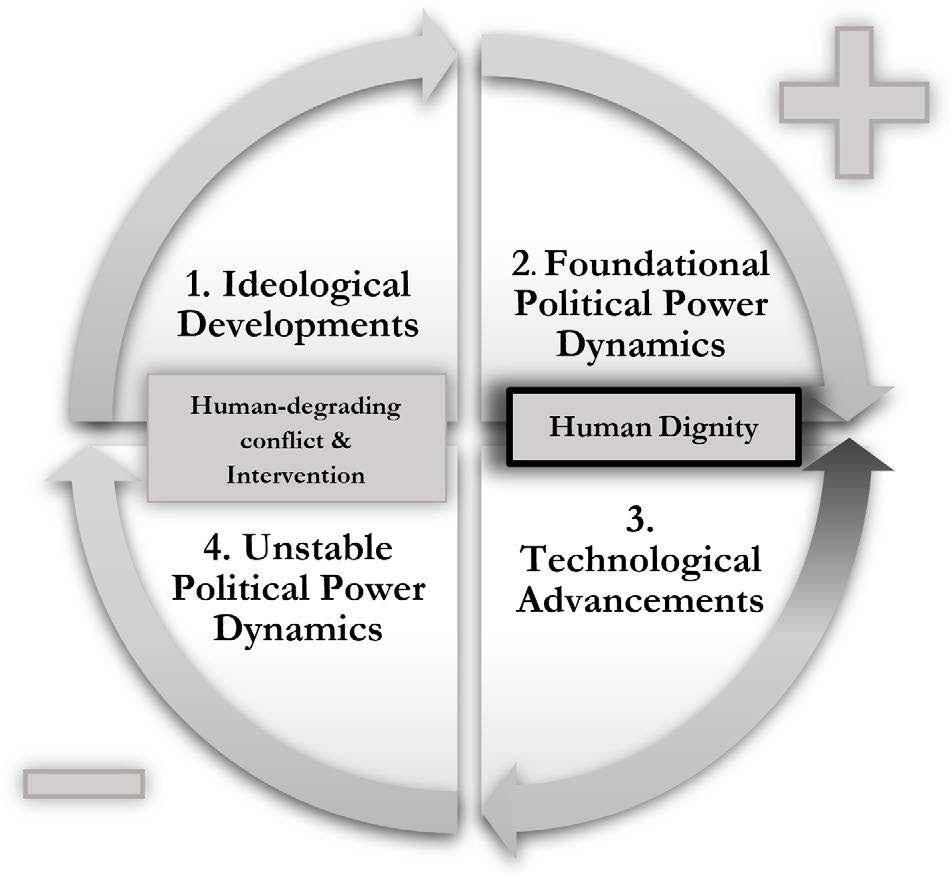
The Cycle of Conflict informs us, consistent with historical research, that as individuals unite under common beliefs (1. ideological developments) they form a system of governance in with those ideologies are carried out (2. Foundational Political power dynamics). The initial aim of the group’s Foundational Political Power Dynamics are aligned with the two foundational beliefs we outlined before, which ultimately allow the group to recognize the inherent human dignity that each individual of the group possesses. To achieve greater ends – in line with the group’s ideologies – the group uses its resources to advance itself (3. technological advancements). These advancements inevitably lead to great wealth, creating centralized sources of power. At this point, the Cycle of Conflict informs us of a critical juncture. A juncture in which the group has the opportunity to ground itself in human dignity or to continue a path of inequality within the group itself (4. Unstable political power dynamics). At this critical juncture, the group is granted a new level of freedom. However, freedom without a corresponding sense of responsibility toward the ‘whole’ inevitably defaults to the preservation of the ‘part’ (the in-group). With power – as human nature suggests historically – comes greed and destabilized political power dynamics that lead to human-degrading conflict on mass scales.
Reflecting once more on the Cycle of Conflict, and its associated factors, it is clear that human dignity does not limit us – it grounds us. It centers our potential to do good and prevents us from being drawn toward human-degrading conflict. While we often associate human dignity with ideological theories, throughout history, it has been deeply tied to belief systems as a means of understanding the value of the human person. Yet, unlike other ideological theories, human dignity is notoriously difficult to integrate into practice, particularly in political and technological initiatives. Human dignity is not merely a status we possess; it is a responsibility we carry for one another. To ground a decision in dignity is to acknowledge that our freedom to advance technologically must be tethered to our responsibility to ensure that advancement does not come at the cost of another’s value.
By placing the value of humanity as a whole at the center of our decisions, we create a framework that transcends divisions and seeks the good of all, regardless of group affiliation. This universal focus is not only necessary for addressing the challenges posed by modern technology but also fundamental to ensuring that technological advancements serve to uphold, rather than degrade, the shared dignity of all people.
We asked: why does conflict exist? We found that while conflict is an inevitable byproduct of our intellectual freedom, human-degrading conflict is a failure of our intellectual responsibility. It is not enough to be free to ideate and advance; we must be responsible for the direction of that advancement. By grounding our decisions in human dignity, we transform our freedom from a tool of division into a foundation for universal thriving.