
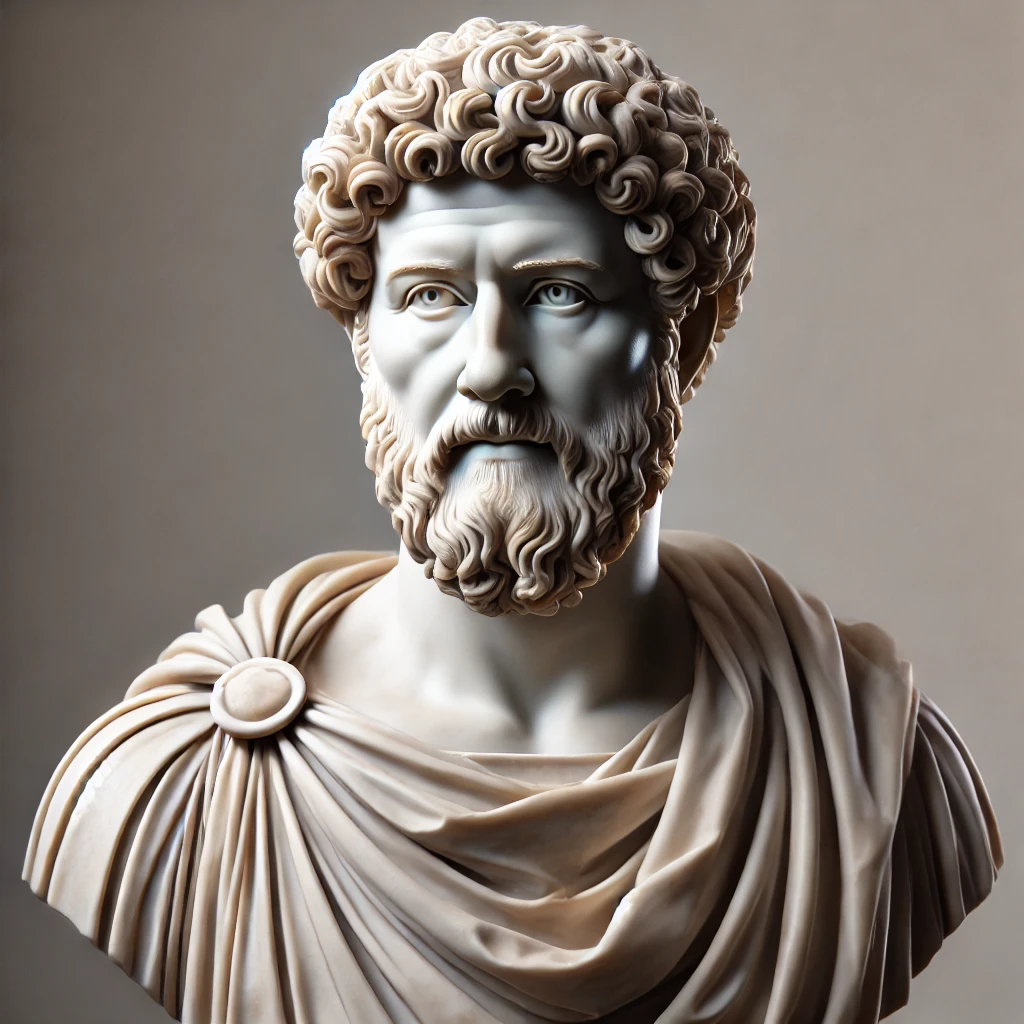
In our book, Conflict: Recognizing Human Dignity as a Solution to Humanity’s Greatest Challenges, we analyze Marcus Aurelius (121 to 180 CE) as a unique figure who balanced the highest levels of Political Power Dynamics with a profound commitment to internal Ideological Development.[1] As both a Roman Emperor and a Stoic philosopher, he personified the struggle to maintain the “fabric of humanity” while managing the immense pressures of an empire frequently embroiled in conflict.
Marcus Aurelius: The Stoic Emperor and the Inner Citadel
Marcus Aurelius’s reign was marked by constant border wars and internal strife. However, he is remembered today not for his military conquests, but for his Meditations—a personal record of his efforts to exercise responsible freedom.[2] In our book, we argue that dignity is an innate characteristic rooted in our “intellect” and “rational capacity.” Marcus Aurelius lived by this principle, believing that while we cannot always control external events or the “Cycle of Conflict,” we have absolute sovereignty over our own minds.
At the Freedom and Responsibility Institute, we observe how Stoicism provided a framework for recognizing the “intrinsic worth of the human person” across all levels of society. Marcus Aurelius viewed every person as a “fellow citizen of the world,” a perspective that challenges the “in-group and out-group bias” that so often fuels human-degrading conflict.[3]
Ruling with Empathy and Logic
Managing the Political Power Dynamics of Rome required a leader who could resist the “temptation of dominance.” Marcus Aurelius used his “rational capacity for problem-solving” to approach governance as a service to the “common good.” In our book, we note that when leaders prioritize “self-interest” over the “welfare of the governed,” they inevitably drift into the Cycle of Conflict. Marcus Aurelius fought this drift by reminding himself daily to treat even his enemies with the respect due to a rational being.
He understood that “information and clarity” are essential for justice. By applying the “Law of Virtue” to his role as Emperor, he sought to ensure that the laws of Rome reflected a “foundational reason for respecting our neighbors.”
Resilience in the Face of Conflict
Throughout his life, Marcus Aurelius faced “human-degrading” circumstances, from the Antonine Plague to Germanic invasions. Yet, he viewed these not as excuses for aggression, but as opportunities to practice “moral virtues.” As we explore in our book, “healthy conflict” can drive us to innovate, but it requires a “recognition of shared dignity” to prevent it from becoming destructive.
Marcus Aurelius paved a path that shows us how to remain a “thread” of integrity within the larger fabric of humanity. His life serves as a reminder that the preservation of dignity begins with the individual’s choice to act with “intellect and empathy,” regardless of the chaos surrounding them.
This article is part of our Historical Figures series on the History of Human Dignity.
Sources
-
- Stanford Encyclopedia of Philosophy. “Marcus Aurelius.” plato.stanford.edu. ↩
- Britannica. “The Meditations of Marcus Aurelius.” britannica.com. ↩
- Internet Encyclopedia of Philosophy. “Stoicism and the Citizen of the World.” iep.utm.edu. ↩
Contribute to the Dialogue