
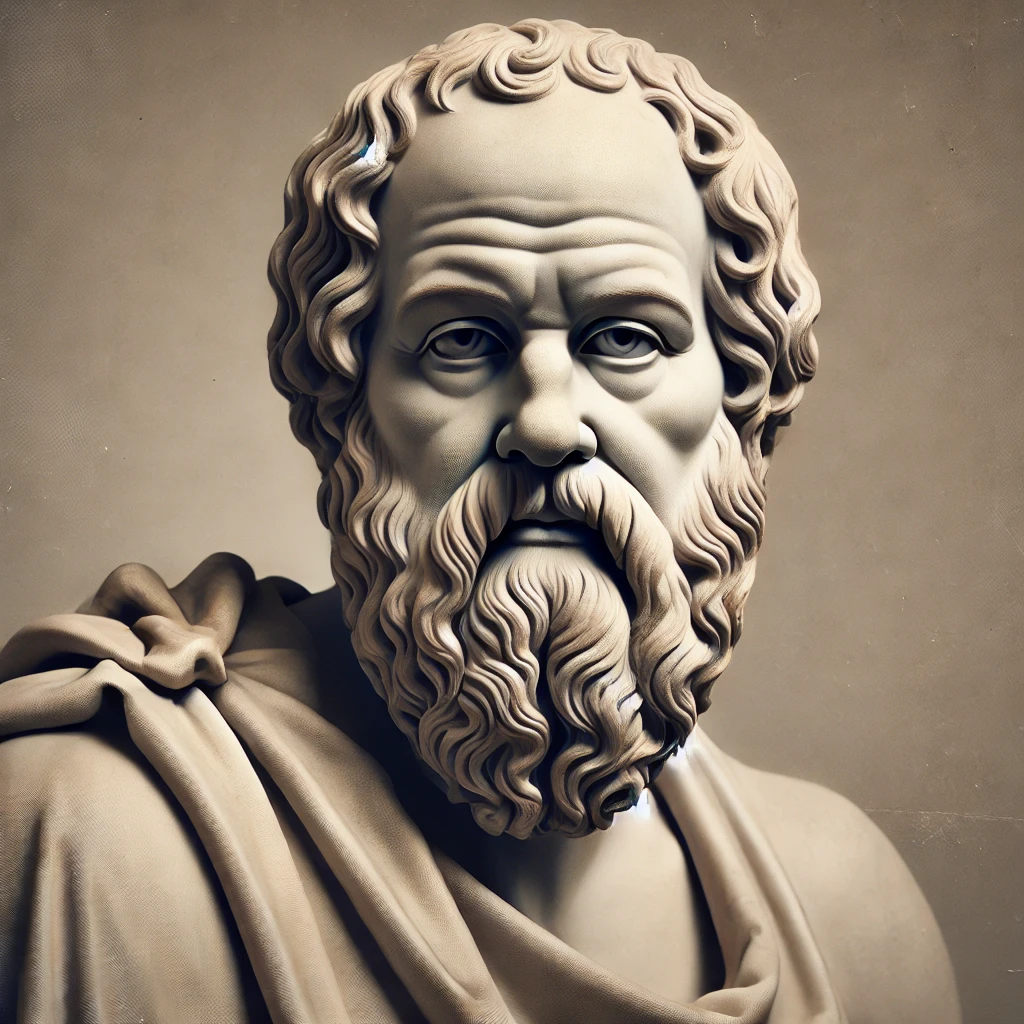
In our book, Conflict: Recognizing Human Dignity as a Solution to Humanity’s Greatest Challenges, we analyze Socrates (469 to 399 BCE) as a pivotal figure of the Axial Age, a period where influential thinkers emerged contemporaneously across different civilizations to challenge existing norms.[1] Socrates personifies the Ideological Development of using “rational capacity” as a primary defense against the human-degrading conflict that occurs within “Cycle of Conflict“.
Socrates: Rational Capacity and the Defense of the Soul
Socrates lived during an era of profound instability in Athens. The Political Power Dynamics of the time were defined by the aftermath of the Peloponnesian War (431 to 404 BCE), a conflict that reflected a recurring theme of political power-seeking at the expense of human dignity.[2] While many sought security through the “Law of Force,” Socrates proposed that the ultimate security of a society rests on the moral integrity and independent agency of its citizens.
Each human being possesses a “unique dignity among nature,” defined by innate characteristics like “free will, moral virtues, and intellect”. Socrates’ famous assertion that “the unexamined life is not worth living” directly links these “unique intellectual and moral capacities” to the preservation of the “fabric of humanity”.[3]
The Confrontation with Power Dynamics
Socrates’ commitment to truth eventually placed him in direct conflict with the political authorities of Athens. In the language of our book, he was challenging the human-degrading tendency of the state to place its own preservation above the “intrinsic worth of the human person”. He argued that a person’s mindset—whether grounded in “empathy and respect” or “fear and self-interest”—determines the course of history.
When sentenced to death, Socrates chose to maintain his dignity rather than flee. In doing so, he demonstrated that responsible freedom often requires standing by principles even when faced with the “Law of Force”.[4] He showed that while a state can destroy the body, it cannot diminish the “absolute value” of a soul committed to truth and the “recognition of universal human dignity”.
Problem-Solving and the Fabric of Humanity
As we explore in our book, each human being is a “thread” in the “fabric of humanity”. Socrates’ life was dedicated to ensuring those threads remained strong by encouraging “healthy conflict”—the “friction of ideas” that leads to “innovation and problem-solving” rather than destructive suffering. He paved the way for societies to evolve beyond human-degrading ideas by prioritizing individual conscience over state dominance.
Socrates’ legacy reminds us that we begin to lose respect for human dignity when we stop asking “why?” and instead accept a “reduction in our freedom”. His work serves as a foundational reason for respecting our neighbors and moving forward together on the journey of life.
This article is part of our Historical Figures series on the History of Human Dignity.
Sources
-
- Stanford Encyclopedia of Philosophy. “Socrates.” plato.stanford.edu. ↩
- National Hellenic Museum. “The Trial of Socrates.” nationalhellenicmuseum.org. ↩
- Harvard Center for Hellenic Studies. “Plato’s Apology of Socrates.” chs.harvard.edu. ↩
- Bryn Mawr Classical Review. “Socrates Against Athens: Philosophy on Trial.” bmcr.brynmawr.edu. ↩
Contribute to the Dialogue